

Cataract surgery is the most frequently performed and successful microsurgical procedure in modern medicine. Today, cataract surgery is not merely about removing a cloudy natural lens—it is an opportunity to achieve refractive freedom, correcting pre-existing myopia, hyperopia, and astigmatism in a single, 15-minute outpatient procedure.
Contents
- 1. What Happens During Modern Phacoemulsification?
- 2. Navigating the Intraocular Lens (IOL) Spectrum
- Intraocular Lens (IOL) Type
- Visual Focus Range
- Glasses Independence
- Ideal Candidate Profile
- 3. The Critical Role of Corneal Health in Cataract Outcomes
- 4. Post-Operative Recovery Timeline & Safety Protocols
- Restore Clear Vision at Infinite Vision Care
If you or an aging family member are experiencing progressive blurriness, consulting a fellowship-trained eye specialist in Mira Road at a modern eye clinic in Mira Road will help you navigate your lens and surgical options.
1. What Happens During Modern Phacoemulsification?
Gone are the days of large incisions, stitches, and weeks of heavy eye patches. Modern cataract extraction utilizes Micro-Incision Cataract Surgery (MICS) via Phacoemulsification:
Micro-Incisions ──► Ultrasonic / Laser Emulsification ──► Foldable IOL Implantation
- Precision Micro-Incisions: Self-sealing, stitchless incisions measuring less than 2.2 mm are created at the corneal periphery under topical drop anesthesia.
- Capsulorhexis & Emulsification: A circular opening is made in the lens capsule, and high-frequency ultrasound gently breaks the cataract into microscopic particles before vacuuming them away.
- Foldable IOL Implantation: An artificial intraocular lens (IOL) is injected through the micro-incision, unfolding into place inside the capsular bag to provide clear, lifelong focusing power.
2. Navigating the Intraocular Lens (IOL) Spectrum
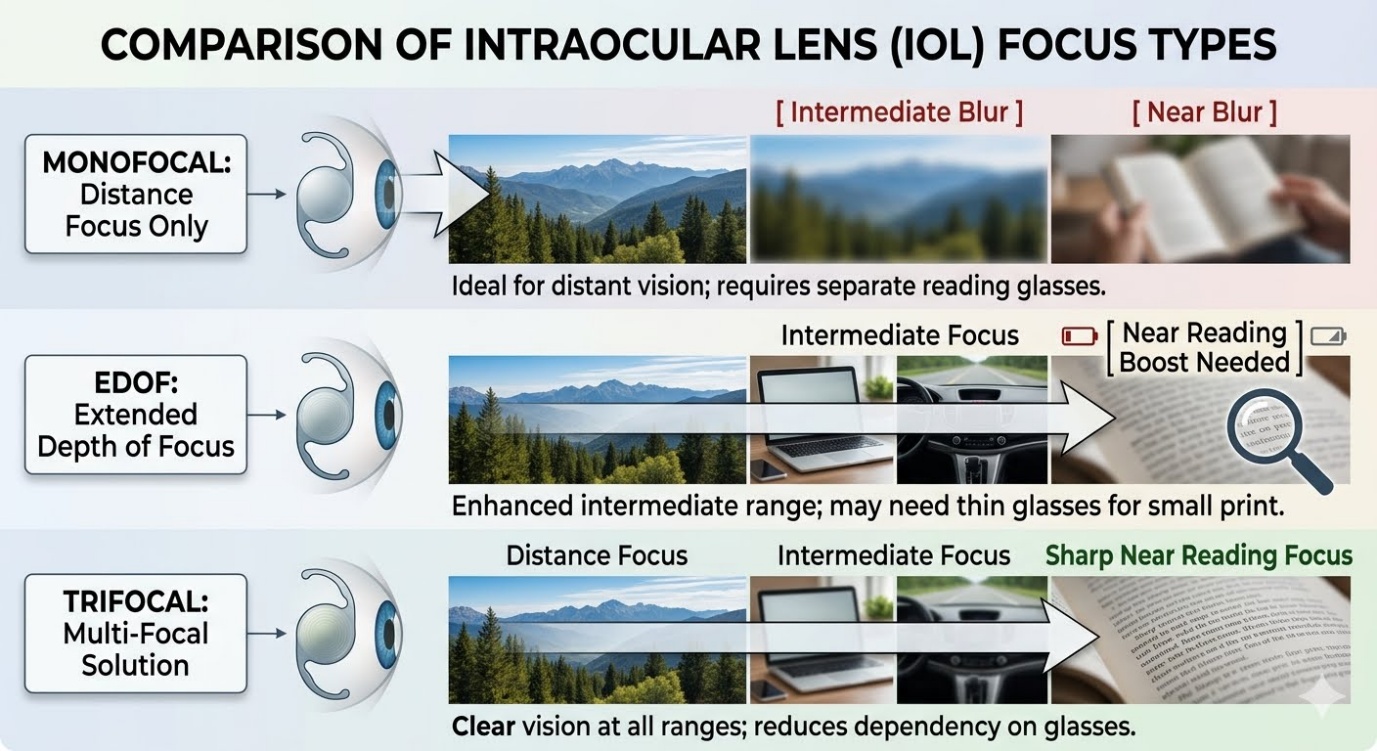
The quality of your vision after cataract surgery depends directly on the optical design of the intraocular lens you select.
Intraocular Lens (IOL) Type |
Visual Focus Range |
Glasses Independence |
Ideal Candidate Profile |
|
Standard Monofocal |
Distance only |
Intermediate and reading glasses required |
Patients prioritizing sharp distance clarity on a budget. |
|
Toric IOL (Astigmatism) |
Custom cylinder correction for distance |
Corrects pre-existing corneal astigmatism |
Patients with of corneal astigmatism. |
|
Extended Depth of Focus (EDOF) |
Continuous distance to intermediate (~60 cm) |
Glasses rarely needed except for fine, close print |
Active drivers, laptop users wanting minimal night glare. |
|
Trifocal / Multifocal |
Distance, intermediate (screens), and near (reading) |
Up to 90–95% complete glasses independence |
Patients desiring total freedom from reading glasses. |
3. The Critical Role of Corneal Health in Cataract Outcomes
A successful cataract surgery requires more than a premium lens—it demands a healthy corneal surface and an accurate ocular baseline. Subclinical corneal dry eye, irregular astigmatism, or endothelial weakness (such as Fuchs’ dystrophy) can reduce the visual performance of advanced multifocal lenses if left unaddressed.
This is why consulting a cornea-specialized Ophthalmologist in Mira Road or an experienced Ophthalmologist in Kandivali is invaluable. A corneal specialist uses advanced optical biometry and specular microscopy to verify that your corneal endothelium and surface architecture can support your chosen lens design.
4. Post-Operative Recovery Timeline & Safety Protocols
Recovery after modern phacoemulsification is smooth and predictable:
- Day 1: Visual clarity begins to sharpen significantly within 24 hours. Mild scratchiness is normal.
- Week 1: Antibiotic-steroid eye drops prevent infection and control inflammation. Normal walking, reading, and light computer work can resume.
- Month 1: The corneal interface is completely healed, the intraocular lens is fully stabilized, and a final refractive check is completed.
Restore Clear Vision at Infinite Vision Care
For patients seeking the highest standard of surgical care in North Mumbai, Dr. Shaila Rajkumar Patel at Infinite Vision Care and Laser Centre offers unmatched expertise:
- Cornea & Phaco-Refractive Specialist: Having performed thousands of successful micro-incision cataract and LASIK surgeries, Dr. Patel tailors every lens calculation with sub-micron precision.
- NABH-Accredited Center: Equipped with advanced operating microscopes, phacoemulsification systems, and optical biometers.
- Patient-First Philosophy: Clear, compassionate guidance to match your daily lifestyle and hobbies with the right lens technology.
Book your cataract evaluation with a trusted eye doctor in Mira Road at Infinite Vision Care today.
Key Takeaways
- Cataract surgery utilizes Micro-Incision Cataract Surgery (MICS) and Phacoemulsification, featuring self-sealing incisions less than 2.2 mm with no stitches required.
- The type of intraocular lens selected during cataract surgery significantly impacts the quality of vision post-operation, with options like Standard Monofocal, Toric, Extended Depth of Focus, and Trifocal lenses available.
- Healthy corneal surface and accurate ocular baseline are crucial for successful cataract surgery outcomes, as issues like corneal dry eye can affect the performance of advanced multifocal lenses.
- Post-operative recovery after modern phacoemulsification shows significant improvement in visual clarity within 24 hours, with normal activities resuming within a week and final checks completed by the end of the first month.
- Dr. Shaila Rajkumar Patel at Infinite Vision Care specializes in micro-incision cataract surgeries, incorporating advanced technology and a patient-first approach to tailor lens calculations.